

Role of Resin Molds: Transforming Resin Art Projects


For many resin artists, shaping liquid into vibrant art begins with the right mold. The challenge is that even the most creative designs can fall flat without understanding how mold choice determines detail, durability, and ease of release. Whether you work from a home studio in Texas or a bustling workshop in Toronto, mastering the art of custom molds for resin creations lets you tackle complex designs while sidestepping common project headaches.
Table of Contents
Key Takeaways
Point | Details |
Mold Selection is Crucial | The type of mold you choose directly affects the quality, detail, and strength of your resin artwork. Opt for silicone molds for intricate designs and versatility. |
Understanding Mold Features | Key features like wall thickness and draft angles significantly influence casting success. Pay attention to these details to minimize defects and ease demolding. |
Adhere to Proper Techniques | Accurate mixing and environment control are essential to avoid common mistakes such as tacky finishes or trapped bubbles. Always measure and mix resins carefully. |
Document and Analyze Your Process | Keep detailed records of your casting projects to identify patterns that lead to successful outcomes. This practice will help refine your techniques over time. |
Defining Resin Molds in Artistic Creation
A resin mold is fundamentally a hollow form that shapes liquid resin into a desired three-dimensional figure. Think of it as the negative imprint of your final artwork. When you pour liquid resin into a mold, the liquid takes on every contour, texture, and detail of the mold’s interior surface. This is where the magic happens for resin artists: your mold becomes the blueprint for your entire piece. The mold captures every microscopic detail you want to replicate, meaning small imperfections or intentional textures all transfer directly to your finished resin artwork.
Silicone has become the industry standard for resin molds, and for good reason. Unlike rigid materials such as plastic or plaster, silicone possesses remarkable elasticity that allows you to flex and bend the mold to release your cured resin without damage. This flexibility is non-negotiable when working with detailed or undercut designs where a rigid mold would trap your resin and cause breaking or surface damage. Silicone also captures extraordinary detail fidelity—every line, texture, and fine feature of your original design transfers faithfully to each cast. Artists value silicone specifically because its elastomeric properties protect resin pieces during unmolding while maintaining intricate surface details that define quality resin art.
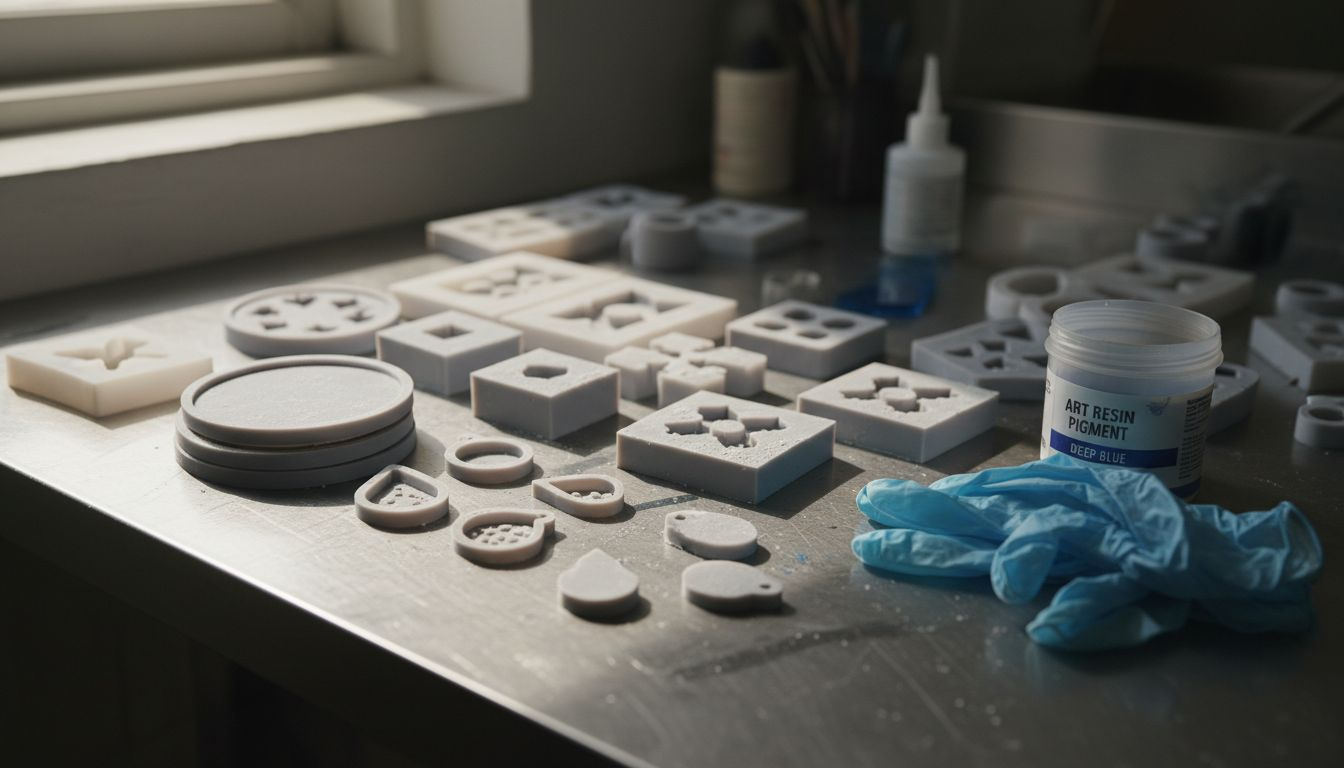
The relationship between mold and artist represents a merger of artistry with technical precision. Custom molds enable you to move beyond basic shapes and create truly intricate, one-of-a-kind designs that would be impossible to achieve freehand. You might start with an original sculpture, hand-carved piece, or even a 3D-printed prototype. From that original, you create a silicone mold that preserves every detail. Once you have that master mold, you unlock the ability to produce multiple identical castings, each one as detailed as your original design. This is where resin molds transform from simple containers into creative tools that expand what you can actually accomplish as an artist.
What makes molds particularly valuable for resin artists is how they solve real production challenges. Molds control bubble formation during pouring by directing resin flow in specific ways. They maintain consistent wall thickness throughout your piece, which affects both curing efficiency and the final strength of your artwork. Custom molds play a crucial role in resin art by defining shape and structure while enabling production of intricate designs that overcome common technical obstacles. Whether you’re creating jewelry, decorative home pieces, or sculptural work, the right mold directly impacts your success rate and the quality of finished pieces coming out of your studio.
Pro tip: Start with simple silicone molds from established suppliers to understand how different mold designs affect your pouring technique and final results before investing time and materials into creating custom molds.
Common Types of Resin Molds for Art and DIY
Not all molds are created equal, and choosing the right type for your project directly impacts your success and enjoyment. The mold world breaks down into four main categories, each with distinct advantages and limitations. Understanding these differences helps you make smart decisions about what to buy, what to make, and how to approach different projects. Your choice comes down to balancing design complexity, durability needs, budget, and how many pieces you plan to cast. Some artists use multiple mold types for different phases of their work, while others settle into a single preferred option.
Silicone molds dominate the resin art world for good reason. These molds offer unmatched flexibility, allowing you to easily remove detailed or undercut pieces without stress or damage. Silicone captures microscopic details and resists degradation from repeated use, meaning a well-made silicone mold can produce dozens or even hundreds of identical castings. The elastomeric nature of silicone also forgives minor mistakes during pouring. Temperature fluctuations during curing rarely cause problems because the silicone expands and contracts slightly with your resin. Plastic molds represent the budget-friendly opposite end of the spectrum. They work wonderfully for simple geometric shapes like spheres, cubes, pyramids, or basic rectangular blocks. Plastic molds are rigid, durable, and inexpensive, making them perfect for beginners experimenting with resin or artists working with tight budgets. The trade-off is that plastic cannot bend or flex, so intricate details or undercuts often trap resin, requiring destructive demolding that damages your finished piece.
Metal molds occupy a niche space in resin crafting. These molds excel in durability and can withstand years of heavy production use without degradation. Metal transmits heat differently than silicone or plastic, which can actually speed curing times for some epoxy resins. However, metal molds require careful handling, as they can dent or scratch. They are heavier to work with, more expensive upfront, and typically suited to production artists running high-volume operations rather than hobbyists. Custom molds represent the pinnacle of specialization. Whether you commission a mold maker or create one yourself using silicone rubber, custom molds let you capture any design imaginable. Selecting the right mold type depends on design complexity, material compatibility, durability, and reusability requirements. A custom mold might be a luxury investment for a single cherished design, or it might be the foundation of an entire product line that you cast repeatedly.
Your actual choice depends on asking yourself honest questions. Are you making a one-time decorative piece or building a product line? Do you need extreme detail, or will simpler forms serve your vision? How many castings do you anticipate making? If you are just starting out, plastic or silicone beginner sets offer low-risk ways to learn. If you have a signature design that customers love, investing in a custom silicone mold becomes economical after your first 20 or 30 sales. Many experienced artists stock multiple mold types, grabbing silicone for detailed work, plastic for quick geometric forms, and custom molds for their most distinctive pieces.
Here’s a quick reference comparing common resin mold materials for artists:
Mold Material | Detail Capture | Durability | Demolding Ease |
Silicone | Highest | Excellent | Very easy |
Plastic | Moderate | Good | Difficult with details |
Metal | Good | Outstanding | Challenging |
Custom (Silicone) | Highest | Varies | Tailored to design |
Pro tip: Start by experimenting with affordable plastic and silicone molds from various suppliers to understand how different mold materials and shapes affect your pouring technique, curing time, and demolding ease before committing to custom mold creation.
How Resin Molds Shape Project Outcomes
Your mold choice does far more than just hold resin. It fundamentally determines whether your finished piece becomes a success or a disappointment. The mold you select influences surface quality, dimensional accuracy, structural integrity, and even how quickly your resin cures. Think about it this way: a mold is essentially printing instructions for your artwork. Different molds execute those instructions with varying degrees of precision, affecting everything from the smoothness of your final surface to the strength of thin walls or detailed features. This is why experienced resin artists obsess over mold selection. They understand that the best resin and the most careful technique cannot overcome limitations built into a poor mold.
The most immediate impact shows up in surface quality and detail capture. Silicone molds capture extraordinarily fine textures and surface details because the material itself flexes at microscopic scales. If your original design has subtle brush strokes, wood grain texture, or carved patterns, silicone preserves every nuance. Plastic molds handle basic geometry beautifully but struggle with fine details and complex curves. The material simply cannot conform to every contour the way silicone does. Metal molds fall somewhere between, offering good detail capture for geometric or semi-geometric designs but requiring perfectly smooth surfaces on the original model to avoid defects translating to every single cast. Molding parameters like material elasticity, mold support systems, and resin infusion behavior directly impact artifact fidelity and surface quality, meaning your mold choice determines whether details transfer faithfully or become blurred and indistinct.
Your mold also shapes how evenly your resin cures and how strong your final piece becomes. Thin-walled sections require molds that allow consistent resin flow without trapping air bubbles. Silicone’s flexibility means you can apply external pressure or vibration techniques to release trapped bubbles, something impossible with rigid plastic or metal molds. Wall thickness consistency depends on the mold’s ability to maintain uniform depth and support the resin weight during curing. A mold with inadequate support or uneven internal dimensions produces pieces with weak spots, stress points, or areas prone to cracking over time. This explains why custom molds command premium prices for serious artisans. When a mold is engineered specifically for your design, it accounts for resin behavior, weight distribution, and curing dynamics.
Beyond technical performance, molds shape your creative flexibility and production efficiency. A silicone mold accommodates experimentation: you can try different resin types, add pigments and inclusions, embed objects, or layer multiple colors without worrying about the mold degrading or your piece sticking. This freedom to experiment drives innovation in resin art. Rigid plastic molds lock you into one approach. Once you pour resin into a plastic mold, your options narrow dramatically. You cannot easily fix mistakes, adjust colors mid-pour, or modify your design without starting fresh. Production artists choose molds based on how many pieces they anticipate casting. A mold destined for 500 castings needs durability and consistency that a one-time mold does not. This affects your material budget and timeline. A $30 silicone mold becomes economical after just 50 pieces, while a $200 custom mold requires higher volume to justify the investment. Understanding these outcomes upfront prevents wasted materials and frustration down the road.
Pro tip: Before committing to a mold purchase, pour a test batch with an inexpensive resin to observe how the mold performs with your specific pouring technique and to identify any curing challenges before working with premium or specialty resins.
Essential Features for Quality Casting Results
Quality casting does not happen by accident. It results from understanding which mold features matter most and why they matter. The best molds share specific characteristics that directly translate to superior finished pieces. These features work together as a system, meaning overlooking even one creates problems downstream. Your awareness of these features transforms you from someone who simply pours resin into someone who actively controls outcomes. This knowledge separates artists who consistently produce gallery-quality work from those who struggle with defects and inconsistencies.
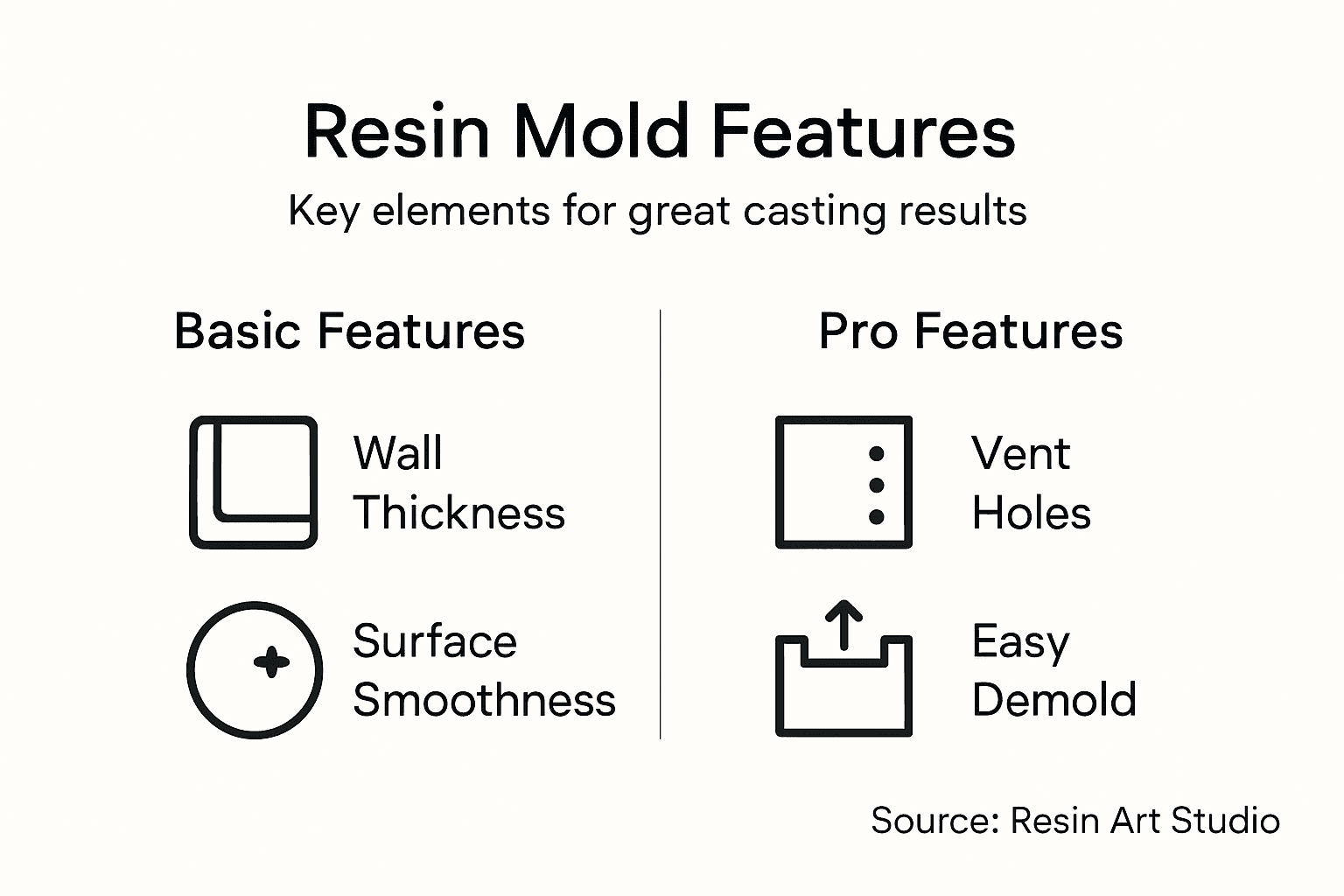
Mold wall thickness stands at the foundation of quality casting. Walls that are too thin flex excessively during pouring, causing dimensional inconsistencies and weak final pieces. Walls that are too thick absorb excessive heat and slow curing to frustrating timeframes. Industry standards suggest walls between one-quarter and one-half inch thickness, though this varies based on mold material and casting size. Silicone molds benefit from support systems that prevent excessive flexing while still allowing demolding flexibility. Many serious artisans reinforce silicone molds with plaster or fiberglass jackets that hold the shape without compromising the silicone’s release properties. Draft angles matter equally. A draft angle is a slight taper built into the mold’s interior walls, angling outward from bottom to top. This seemingly minor detail prevents your resin from locking onto the mold during demolding. Without adequate draft angles, even flexible silicone molds fight against cured resin, risking tears or distortion. Standard draft angles range from one to three degrees depending on design complexity. Accurate mold design with appropriate draft angles and wall thickness directly contributes to superior casting outcomes by ensuring consistent dimensions and easy demolding.
The mold’s internal surface finish determines surface quality on your finished piece. Any texture, roughness, or imperfection on the mold’s interior translates directly to your resin piece. This is why professional mold makers spend considerable time polishing and finishing mold interiors. A rough mold produces rough castings that require extensive sanding and finishing work. A well-finished mold produces pieces that emerge nearly ready for use. Material selection intersects directly with finish quality. Silicone naturally resists dust and debris better than plastic, making it easier to maintain a clean surface. Plastic molds require careful handling and storage to prevent scratching and contamination. The correct pairing of resin and mold material ensures compatibility and prevents chemical reactions that cloud or damage castings. Some specialty resins require specific mold types. Using the wrong combination wastes materials and produces disappointing results. Temperature control during curing ties directly to mold performance. Molds with poor insulation properties experience uneven curing, with edges hardening faster than centers. This creates internal stress and potential cracking. Molds that maintain consistent temperature throughout produce resin that cures uniformly, resulting in stronger, more durable pieces with better color consistency.
Bubble prevention features separate premium molds from basic ones. Strategic vent holes positioned at high points allow trapped air to escape as resin flows in. Without adequate venting, bubbles become trapped and create visible defects or weak spots. Some high-end silicone molds incorporate micro-porous channels designed specifically for bubble release. The mold’s entry point matters significantly. Pouring from an optimal location ensures gravity-driven flow that pushes air upward toward vents rather than trapping it deep within the cavity. This is why custom molds designed for your specific project outperform generic molds. They account for your design’s unique geometry and resin flow patterns. Mold release agent compatibility rounds out the feature list. Some molds work best with specific release agents, while others perform poorly with certain formulations. A quality mold typically accommodates multiple release agent types, giving you flexibility and preventing sticking issues. Understanding these interconnected features means you can diagnose problems before they ruin your artwork. A failed casting usually traces back to one of these elements, and knowing which features to evaluate speeds your troubleshooting and improvement process.
Below is a summary of essential mold features and their impact on casting quality:
Mold Feature | Why It Matters | Impact on Results |
Wall Thickness | Structural support | Prevents flex, ensures consistency |
Draft Angle | Demolding efficiency | Easier release, protects fine details |
Surface Finish | Final piece appearance | Less finishing work, higher gloss |
Bubble Prevention | Reduces resin defects | Fewer visible flaws, improved strength |
Pro tip: Document your casting results with each mold you own by noting resin type, curing temperature, pouring technique, and any defects that appear, creating a personal reference guide that reveals which molds perform best under your specific working conditions.
Avoiding Mistakes and Improving Resin Projects
Most resin artists learn by making mistakes. The question is whether you learn from your own failures or from others. Understanding common pitfalls accelerates your progress dramatically and saves materials, time, and frustration. The mistakes that plague beginners follow predictable patterns, and recognizing these patterns before they derail your work separates successful projects from expensive learning experiences. Your mold plays a central role in many of these mistakes, which means improving your mold knowledge directly prevents failures.
Mixing ratio errors top the list of preventable disasters. Resin and hardener exist in precise ratios, usually two-to-one or one-to-one depending on the product. Using eyeballed measurements or approximate guesses creates batches that never fully cure, remain tacky indefinitely, or cure too quickly and trap bubbles. A $5 digital scale pays for itself after a single failed batch. Weigh your resin and hardener separately on that scale rather than pouring by eye. The second critical mistake involves inadequate mixing. Slow, gentle mixing over 2 to 3 minutes minimizes bubble introduction while ensuring the resin and hardener fully combine. Fast vigorous mixing whips air into your batch, and those bubbles persist in your finished piece unless you spend hours trying to extract them. Your workspace environment matters equally. Temperature below 65 degrees Fahrenheit slows curing and allows more time for bubbles to rise, but it also prevents proper polymerization if it drops further. Humidity above 70 percent introduces moisture that clouds your resin and creates a grainy, milky appearance. Keep your workspace between 70 and 75 degrees with humidity below 50 percent if possible. This single adjustment prevents more problems than nearly any other technique.
Mold preparation represents another critical success factor. A dirty mold traps dust particles that become visible defects in your casting. Wipe your mold interior with a lint-free cloth before each use. Apply a thin, even coat of release agent appropriate for your mold material. Too much release agent leaves a coating on your finished piece that requires cleaning. Too little leaves your resin sticking to the mold, necessitating destructive demolding. Common resin project mistakes including incorrect mixing and poor mold preparation create preventable defects that compromise clarity, strength, and appearance. Safety precautions separate casual hobbyists from serious artists. Wear nitrile gloves, work in ventilated areas, and avoid inhaling vapor. Resin off your skin with rubbing alcohol immediately after contact. Use eye protection because resin splashes sting and can cause damage. These are not exaggerated warnings. Resin can cause skin sensitization, respiratory irritation, and eye damage if proper precautions are ignored.
Improvement comes from systematic troubleshooting when problems occur. Cloudy or milky resin almost always traces back to humidity or temperature issues. Sticky resin that never fully cures means incorrect mixing ratios or insufficient hardener. Visible bubbles indicate either fast mixing, trapped air in your mold, or inadequate pouring technique. Weak or brittle castings suggest improper ratios or curing in too-cold conditions. By connecting symptoms to causes, you diagnose what went wrong and adjust your next batch accordingly. Keep detailed notes on every project: mold type, resin batch number, mixing time, temperature, humidity, curing time, and any defects. Over time, patterns emerge revealing which combinations produce your best results. Some molds perform better in warm conditions. Some resin types cure faster in humid environments. Your notes become your personal playbook for success. The path from frustrated beginner to confident artist runs through accumulated knowledge. Every failed piece teaches you something if you pay attention. Document your learning, and future projects benefit from past experience.
Pro tip: Create a simple spreadsheet tracking each casting you make with columns for mold type, resin type, temperature, humidity, and final result, then review quarterly to identify which combinations consistently produce your best work.
Unlock the Full Potential of Your Resin Art with Precision Molds and Supplies
Struggling to find the right molds that deliver flawless detail, easy demolding, and consistent results Often, choosing the perfect resin mold feels overwhelming, especially when quality and durability directly influence your finished artwork’s success. This article shows how proper mold selection overcomes challenges like bubble formation, curing inconsistencies, and delicate demolding. At Krystal Resin, we understand these pain points and provide a curated selection of high-quality silicone molds and complementary resin supplies designed to empower artists, hobbyists, and professionals alike.

Explore our collection at Krystal Resin to start creating pieces with superb surface finish and structural integrity every time. Don’t let imperfect molds hold back your creativity. Visit Krystal Resin now for expert-crafted molds and premium resins that bring your visions to life. Begin your journey to stress-free casting and elevate your resin art projects today.
Frequently Asked Questions
What are resin molds used for in artistic creation?
Resin molds are used to shape liquid resin into three-dimensional figures, capturing every contour and detail of the mold’s interior surface, resulting in intricate artwork.
What materials are commonly used for making resin molds?
Silicone is the most commonly used material due to its flexibility and ability to capture fine details. Other materials such as plastic and metal are also used, but they have limitations in terms of flexibility and detail fidelity.
How do I choose the right mold type for my resin project?
Choosing the right mold type depends on factors like design complexity, durability needs, budget, and the number of castings you plan to make. Silicone molds are ideal for intricate designs, while plastic molds work well for simple shapes.
What are common mistakes to avoid when using resin molds?
Common mistakes include incorrect mixing ratios of resin and hardener, inadequate mold preparation, and pouring techniques that trap air bubbles. Proper preparation and attention to environmental conditions can minimize these issues.
Recommended
Comments